AI describes your business incorrectly
Record the exact question and answer, verify the sources, and distinguish a source problem from a system error.
AI representation / Frontier Intelligence
Make your organization easier to understand—and its claims easier to verify.
A buyer, journalist, employee, or partner may meet your organization through an AI-generated answer. Signal Architecture helps you examine that answer and build a clearer, more credible body of public evidence behind it.
Fall 2026–Spring 2027 edition
By Elizabeth Edwards
Why this belongs in your work
The guide develops Elizabeth Edwards’s Signal Architecture framework through three connected layers: asset, distribution, and reinforcement. You learn to establish the fact, publish it clearly, make it accessible, test its interpretation, and keep the record current.
What you are getting
For PR, communication, reputation, content, and business leaders who own how their organization is found, described, and understood.
Inside the resource
Scan the three areas below. Open any section to see the specific material included.
Selected pages / actual edition
These are real pages from the resource. Select a page to open a larger image. Descriptions below explain what you are seeing.
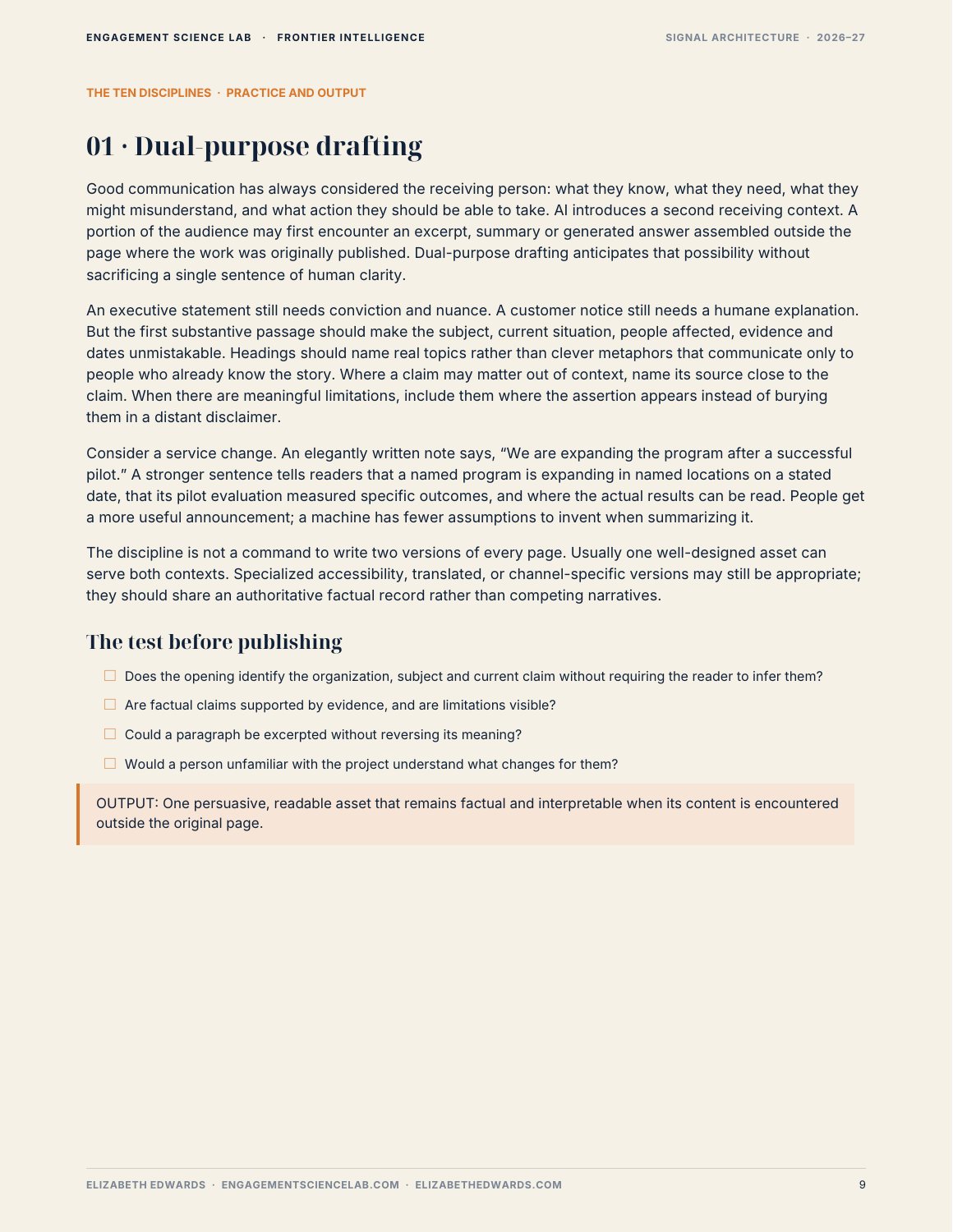 Page 9 · Open larger ↗
Dual-purpose drafting shows how one clear, persuasive asset can serve a person and remain accurate when an AI system excerpts it.
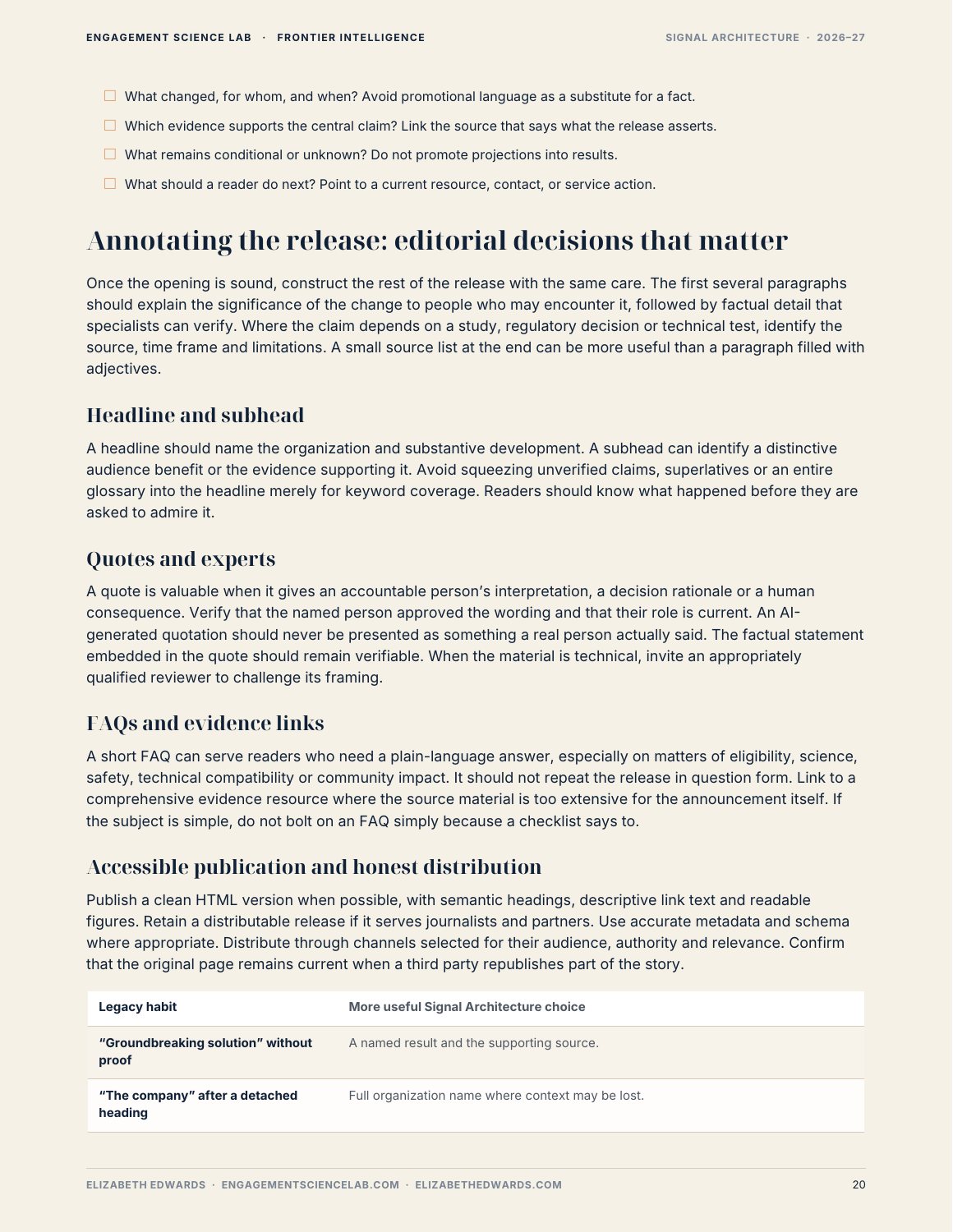 Page 20 · Open larger ↗
The worked release section explains what to change in headlines, evidence, quotes, FAQs, and distribution—and why those choices matter.
Limited sample pages. The complete paid materials are delivered privately after purchaser verification.
Put it to work
Illustrative uses for the method—not claims of guaranteed results.
Record the exact question and answer, verify the sources, and distinguish a source problem from a system error.
Brief the writer around the real audience question, named facts, supporting evidence, dates, and update owner.
Trace a priority fact across pages, profiles, releases, and other records, then assign the corrections that matter.
A verified baseline, a stronger authoritative source, a prioritized correction plan, and a repeatable review routine.
Choose with clarity
This is a communication discipline, not a promise of AI rankings, citations, or favorable answers. Independent systems vary; the aim is a more accurate, useful, and maintainable public record.
Read purchase & access termsIt includes discoverability and machine-readable publishing, but its scope is broader: claim quality, evidence, identity, internal and external coherence, ownership, and correction. It connects those responsibilities to communication that works for people.
No. The guide starts with consequential stakeholder questions, selected AI interfaces, source checks, and a working record. It explains the limits of sampled visibility measurements.
They carry the method into ordinary assignments: a brief, a public explanation, a consistency review, or a recurring answer check. Each names the evidence, decision, next action, and owner.
We review your purchaser details before releasing materials. Delivery is within 48 hours after purchaser verification, rather than immediately after payment. Use an email you check regularly.
The $39 pass is a one-time add-on covering updates and extension-pack upgrades issued for this report during the 12 calendar months after your purchase date. There is no automatic renewal or promised release frequency. It does not include unrelated products or consulting.
The listed license covers internal professional use by the purchaser and their named organization. Resale, redistribution, public posting, and client sublicensing are not included. Contact the Lab about broader use.
Your next step
Signal Architecture · $129 one-time in USD · Optional updates $39.
Bring a focused workshop, tailored learning series, or strategic engagement into your organization.